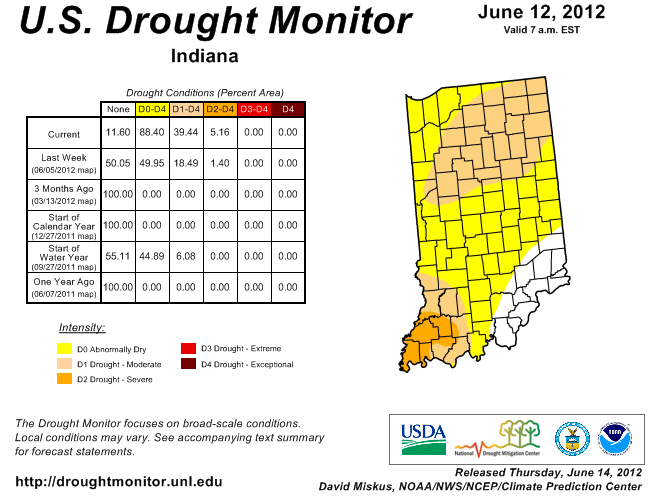
Drought widens and strengthens grip on Indiana


Drought both spread and worsened across Indiana in the past week, with the northern and southwestern portions of the state continuing to suffer the most. Read more...


Read More

Japanese Beetle Emergence and Management

Below is an e-mail conversation that may be of benefit to other turfgrass managers asking similar questions.


Original message:

From: Golf Courses
Date: Friday, June 22, 9:30 AM
To: Gibb, Timothy "Gibb, Timothy" <gibb@purdue.edu>
Subject: Japanese Beetles Management in 2012

With the early spring we expected to see early Japanese Beetles.  We did not really see any at all this spring or even now.  Do you know why?

Last year our grub treatment was very successful and we had little damage from grubs in the fall. With very dry conditions so far this spring and summer and moderately watered fairways, what do you anticipate grub pressures will be like this fall?

High soil temps and dry conditions during the last two months make me think that we may not have much pressure from grubs. Given that is a significant expense to cover even the watered areas for 36 holes, might this be a year to skip treatment?. 

Any thoughts on these ?


Reply:

The Japanese beetles did come out very early this year.  We saw emergence
3 weeks in advance of most years.

A couple of comments to your questions:

(1) The huge numbers and wild fluctuations of Japanese beetle populations that we have experienced in Indiana over the last 20 or so years is starting to moderate. 
This cycle is common with infestations of any new pest.  In early years the populations seemingly run out of control, but over time parasites, diseases and predators naturally catch up and slowly bring the pest numbers down. You will note that Japanese beetles in the Eastern states are not the huge problem that they were when they were first introduced 100 years ago.   Their populations have been moderated significantly over the last two decades or so.  After their first introduction it took them many years to slowly make it westward to Indiana.  Once introduced to our state, they quickly became a serious problem every year.
The last 2 or 3 years have been moderated, however and my opinion is that we are now beginning the moderation phase of the pest cycle in Indiana.

Having said that, we still see spotty population outbreaks of Japanese Beetles
in IN. For every call like yours asking where the beetles have gone, we get another asking where have all the beetles have come from.  The reality is that they are still a very hit/miss pest.


(2) I would am very hesitant about predicting future grub damage based on observations, or non-observations of adult beetles.  We know that from past MRTF sponsored studies, beetle trap catches do not correlate very closely with the presence of grubs or with turf damage later in the summer. I know that this seems non-logical but the reason in part is due to the ability of the beetles to fly long distances in a short period of time. 

Our research in Indianapolis indicates that a mile is no real challenge for a motivated beetle to fly.  This, coupled with the dry season that we are in right now and the fact that you are irrigating your turf, means that beetles down wind of you may be on the verge of moving into your area to lay their eggs.  Irrigated turfgrass is a magnet for beetles in a dry year such as this one.

We have always suggested that if you are going to skip a grub application
with confidence, you have to sample. Sampling is work - but it can also save you pesticide application costs.  It may very well be that you will not
have grubs this year, but I would not count on it just because of a light
beetle flight.  Sampling fairways in August is what I would base my
decision on if I were you.

Hope this helps

Tim Gibb
Read More

2012 Imprelis UPDATE

A new publication, Imprelis Update: 2012 Field Notes on Injury and Recovery, was just developed by Purdue Specialists to address some of the many questions being asked about Imprelis in 2012 including:
  • Did trees recover from Imprelis® injury?
  • Are new symptoms being discovered?
  • What Should I Do if I Suspect Imprelis® Injured Trees BUT I Didn’t Notice the Damage in 2011?
  • What Is OISC’s 2012 Response on this Issue?
  • Can I Do Anything to Help Trees Recover?
  • What Do We Know Now that We Didn’t Then?
  • What Is Taking DuPont So Long?
  • Where Can I Get More Information?
To read the publication visit: 
Imprelis Update: 2012 Field Notes on Injury and Recovery
(PDF) (6/12)

Additionally, to help interested parties better keep track of all the information related to Imprelis, the Purdue Turf Program has created a website that lists important documents from the Purdue Turf Program, Plant & Pest Diagnostic Laboratory, Purdue news releases, Office of the Indiana State Chemist, EPA, and DuPont. Click on the link below to access this site. 
http://www.agry.purdue.edu/turf/ImprelisUpdateLinks.html


Aaron Patton, Turfgrass Extension Specialist


Read More

It’s getting toasty out there! Update on drought and management adjustments

If you like your toast burnt and your bacon crisp, then you might be enjoying this weather. Most of Indiana has entered into drought officially as determined by the drought monitor (see map below). Maps are updated weekly and available at: http://droughtmonitor.unl.edu/monitor.html

Indiana specific weather can also be found at http://iclimate.org/index.asp including maps like the one below showing our precipitation deviation from normal over the past 90 days.

The extended forecast doesn’t look great for rainfall in the near future.Only one of the next 10 days has a chance of rain greater than 30% - and it's only 40%. Additionally, the temperatures are forecasted to be warm and breezy over the next ten days.


Additionally, subsoil moisture levels are approaching that of the 1988 drought due to our dry winter and spring. Image courtesy kingcorn.org/cafe.


How should you adjust your management?
  • Irrigation: See our recent update on this issue by clicking here.
  • Water availability: Many irrigation ponds at golf course are much lower than normal due to insufficient precipitation in winter and spring and golf course superintendents are beginning to conserve water and prioritize which areas that need water most either due to the their soil type, management, or their economic importance (i.e. golf course putting greens). I have heard of no water restrictions, but they might come at some point. Click here to read a previous post on this topic.
  • Fertilization: Fertilization in June is not typical except for irrigated turf. If irrigation is available, then fertilization can proceed as normal based on your typical program. However, if you are managing un-irrigated areas then it would be best not to fertilize during this dry period since drought stressed plants will not take up nitrogen. Additionally, some injury could occur to drought stressed areas from trafficking equipment across the site while fertilizing. We recommend waiting to fertilize unirrigated areas until after the turf greens-up after the next rainfall or in September at the start of our fall fertilization season.
  • Weed Control: See our recent update on this issue by clicking here.
Even the turf at Purdue's president's house is stressed.

Many are irrigating to try and keep turf green and growing; however, just because the turf turns brown doesn't mean its dead. Usually when turf turns brown during drought, it is just entering a drought induced summer dormancy and will green-up when sufficient rain returns.

Aaron Patton, Turfgrass Extension Specialist

Read More

Purdue Annual Turfgrass Research Report

As the green industry continues to have a large impact on Indiana and the nation, Purdue University has assembled an outstanding team of researchers, extension personnel, and educators that are dedicated to solving problems and helping meet the needs of Indiana residents. One segment of the Indiana green industry that continues to provide a significant impact on the state’s economy is the turfgrass industry, which includes residential and commercial lawn care, sports turf, cemeteries, sod production, golf course maintenance, and more. Indiana’s professional turfgrass industry is estimated by some to generate in excess of $1.4 billion in annual expenditures and provide over 11,500 jobs.

The Annual Report of the Purdue University Turf Program is published each year by the Purdue Turf Team and features significant findings made by turfgrass scientists over the past year. It is our desire that this publication will keep our stakeholders up-to-date on significant changes and advancements that affect our industry.

This 2011 Annual Report includes 21 papers from faculty, staff, and graduate students. We hope that these findings will enhance your ability to conduct business in an efficient and productive manner.

We would also like to recognize the many organizations, companies, and individuals who have contributed their time, talent and resources to help make our program successful. We are forever indebted to the many people who contribute to this program. Special recognition goes to the Midwest Regional Turf Foundation which supports the research and extension programs of each member of the Turf Team and also provides substantial support towards the operating and capital expenses of the W.H. Daniel Turfgrass Research and Diagnostic Center.

We hope that this publication will be of value to all persons with an interest in the Indiana green industry. To read more about our recent research, click on the links below or read more from the turf homepage at: http://www.agry.purdue.edu/turf/research-annual-report.html

2011 Turf Research Report - Full Report PDF
Introduction to the 2011 Turf Research Summary PDF
 
Cultivar and Species Evaluations
Evaluation of Putting Green Bentgrass Cultivars and Blends PDF
 
Turf Management
Diverse Responses of Perennial Ryegrass Accessions to Submergence Stress PDF
 
Weed Management
Controlling Poa annua on putting green height turf in Indiana, Michigan, and Nebraska: 2011 Research Update PDF
Controlling Yellow Nutsedge With Sedgehammer+ PDF
Do Granular Herbicide Applications Effectively Control Broadleaf Weeds in Turf? PDF
Efficacy of Current Organic Postemergent Weed Control Options in Turfgrass Systems PDF Evaluation of Crabgrass Control with Various Dimension Formulations and Corn Gluten Meal PDF
Herbicide Safety and Weed Control Comparison in Spring Seeded Kentucky Bluegrass PDF
Herbicide Safety and Weed Control Comparison in Spring Seeded Tall Fescue PDF
Herbicide Selection and Timing Influences Ground Ivy Control PDF
Mowing and Herbicide Effects on Ground Ivy Control in Turf PDF
Preemergence Crabgrass Control with Various Herbicides PDF
Postemergence Broadleaf Herbicide Safety on Putting Greens PDF
Postemergence Ground Ivy Control with Herbicide Combinations PDF
Sequential Applications of Preemergence Crabgrass Herbicides for Enhanced Control – Three Year Summary PDF
 
Insect Management
Evaluating Acelepryn for adult preventive control of billbugs in Kentucky bluegrass turf PDF
Evaluating combinations of Pyriproxyfen and imidacloprid for control of Japanese beetle larvae in Kentucky Bluegrass turf PDF
Influence of application timing on efficacy of granular formulations of grubicides against Japanese beetle larvae in Kentucky bluegrass turf PDF
 
Disease Management
Effects of early season fungicide application on dollar spot outbreaks, 2011 PDF
Integrating fungicide and genetic host resistance for control of dollar spot on creeping bentgrass PDF
Residual efficacy of fungicides for brown patch management on creeping bentgrass, 2011 PDF


Read More

Should I apply an herbicide right now?


Here are some thoughts on summer weed control in non-irrigated areas during periods of drought:
  • Herbicides are ineffective on drought-stressed weeds and can be damaging to drought-stressed turf, especially when temperatures are warm. My rule-of-thumb is that if the lawn is >50% green, then herbicides can be applied.
  • Avoid the temptation to apply herbicides in a dormant (brown) lawn even though weedy species may be obvious as many are drought tolerant perennials, summer annuals, or sedges that grow well even in times of drought.
  • For yellow nutsedge and summer annual weeds (crabgrass, purslane, spurge, etc.), it is better to hold off on applying herbicides until rain returns and the turf begins growing again.
  • For perennial broadleaves, it might be best to wait until fall as these applications are better than spring applications for broadleaf control. 
Yellow nutsedge


Prostrate spurge

Here are some thoughts on summer weed control in irrigated areas during summer:
  • The question I most typically get in this irrigated scenario or during a summer when turf is not drought stressed is, Can I apply an herbicide when temperatures are 85°F or above?
  • First, you will need to follow the herbicide label as each herbicide acts differently.
  • Herbicide applications when daily high temperatures are above 85°F generally increase the risk of turf injury. Most herbicide labels do not prohibit applications at temperatures greater than 85°F or 90°F (each herbicide has a different maximum temperature), but they do caution against their use at these temperatures due to the increased risk for turf injury.
  • A general recommendation is to make the application if the site is more weeds than turf and you are willing to assume the risk of injuring the turf. In most cases, if there are fewer weeds than turf, then it is best to delay making the application until better conditions exist.


Aaron Patton, Turfgrass Extension Specialist
Read More

Early Billbug Damage Reported Across the Midwest

This season continues to challenge our traditional thinking about insect seasonal ecology and management. Indiana and neighboring states are currently witnessing serious billbug infestations with late instar billbug larvae already present in the soil.  This activity is easily 2-3 weeks ahead of normal. We advise all turf managers to take a close look at areas they suspect are displaying symptoms related to drought dormancy. Billbugs cause similar symptoms, but under these conditions they are capable of causing significant damage and loss of turf. Use the tug test to differentiate billbug damage from drought dormancy.  Simply grasp a small group of suspect tillers (brown and dead looking) and pull straight up. If billbug damage is present, the tillers will break-off easily at or just below the soil surface and the bottom ends of some tillers may be packed with very fine sawdust like material (see Figure 1). This is diagnostic for billbug damage. Repeat this process at several locations across the damaged area.


At this time, management options for billbugs are limited to trichlorfon (Dylox), carbaryl (Sevin), or one of the faster-acting neonicotinyls; chlothianidin (Arena) or thiamethoxam (Meridian). Application of these materials should be followed by irrigation (1/4”) or rainfall to wash the applied material into the activity zone of billbug larvae. Over the long term, it may be advisable to renovate susceptible areas to endophyte-enhanced turfgrasses such as perennial ryegrass or tall fescue where agronomically feasible.   


Doug Richmond and Tim Gibb 
Turfgrass Research and Extension Entomologists
Read More