Weed of the month for January 2014 is Annual Bluegrass

Annual Bluegrass 

Biology: Annual bluegrass, commonly referred to by its scientific name Poa annua (sometimes pronounced Po anna on TV), is a winter annual grass that is a difficult-to-control weed in turf. Seeds germinate in late summer, early autumn, and spring. Annual bluegrass is found throughout the United States, particularly in highly compacted, excessively wet soils. Despite having a bunch-type/clumping growth habit (some biotypes have short stolons), it can withstand extremely close mowing heights; thus, allowing the weed to successfully establish in home lawns and other high maintenance turf, such as golf courses or sports fields.

Identification: Annual bluegrass is an upright, clump-forming grassy weed that expands through the development of aggressive tillers. It is generally identifiable by its light green leaf blades that are smooth on both surfaces, have two distinct, clear lines on each side of the midrib, and a boat-shaped leaf tip. Annual bluegrass also has a slightly pointed, membranous ligule. One of the factors that makes annual bluegrass so difficult to control is its ability to produce a large amount of seedheads, even at putting green mowing heights. These seedheads can be observed as a greenish to white, open, pyramid-shaped panicle. A single annual bluegrass plant is capable of producing up to 360 viable seed that have the ability to lie dormant in the soil for many years before finally germinating.

Annual bluegrass is a prolific seed producer
Annual bluegrass membranous ligule

Boat-shaped leaf tip

Annual bluegrass seedhead

Prolific seedhead production

Bunch-type growth habit

Light-green annual bluegrass color in a cool-season lawn. Notice it is growing in a trafficked, compacted area.

Light green color and prolific seedhead production at low mowing heights
Annual bluegrass invading a creeping bentgrass putting green.
Annual bluegrass produces seedheads even at putting green heights

Light green color and prolific seedhead production in a golf course putting green

Cultural control: The use of cultural practices to increase the competitive growth and development of the desired turf over annual bluegrass is one of the limited options for cultural control. However, annual bluegrass’ ability to tolerate extremely low mowing heights and prolific production of viable seed severely limits a professional turf manager’s ability to control the weed using cultural methods.

Biological control: No consistently effective biological control for annual bluegrass although previous research has examined some options.
Chemical control: There are options for controlling bluegrass through the use of herbicides; however, those options are generally specific to the species of the desired turf and the use of the area which is being treated (i.e. home lawns, golf course, sports turf, etc.). One could literally write a book on how to control this species.

To keep annual bluegrass out of your home lawn.
  1. Do not over-water yours lawns as annual bluegrass likes moist areas.
  2. Do not compact your soil through traffic where possible and aerify your lawn to reduce soil compaction as annual bluegrass grows well in thin, compacted areas.
  3. Maintain dense turf through fertilization, overseeding, and weed control (crabgrass and broadleaf weeds).
  4. Mow your lawn at higher heights of cut (>2.5 inches) as annual bluegrass is less competitive at a higher cutting height.
Homeowners should also read, ID and Control of Annual Bluegrass and Rough Bluegrass in Lawns (AY-41-W) 

For professionals, more information on annual bluegrass control is available in Turfgrass Weed Control for Professionals Publication.

For archives of past weed of the month postings, visit our Weed of the Month Archive.

Aaron Patton, Turfgrass Extension Specialist
Leslie Beck, Postdoctoral Research Associate
Read More

Weed of the month for December 2013 is Henbit

Henbit  

Biology: Henbit (Lamium amplexicaule) is a common winter annual broadleaf weed found throughout the United States. It can often be mistaken for another closely related winter annual broadleaf, purple deadnettle. Both can be observed by their showy pink to purple flowers which are primarily produced in April, but can appear from March to November in Indiana.

Identification: Henbit is a winter annual, meaning that it germinates in the fall, survives the winter as a vegetative plant which eventually flowers, develops seed, and dies as temperatures increase in late spring to early summer. As a member of the mint family, henbit has a characteristic four-sided (square) stem which can be sparsely hairy and greenish to purplish in color. All henbit leaves are hairy. Upper leaves are deeply lobed and encircle the main stem at the base (no leaf stem). In contrast, purple deadnettle leaves are more triangular, less deeply lobed, and are more reddish in color than henbit. Henbit flowers are small, pinkish-purple with darker coloring on the lower petal, arranged in whorls, and are tubular in shape.


Early growth stage. Leaves are lobed and round-shaped.

Square-shaped stem

Tubular-shaped flowers

Two-lipped opening at the top of mature flowers

Upper leaves have no leaf stems (petioles)

Leaves toward the base of the plant have long stems (petioles)

Prostrate growth habit in dormant turf

Prostrate growth habit in a landscape

Bermudagrass lawn heavily populated with henbit

Cultural control: Cultural practices that promote a dense, vigorous turf are the best way to reduce the encroachment of annual broadleaf weeds. For example, proper mowing (increased mowing heights), proper fertilization to improve turf density, irrigation to prevent drought stress, and aerification of compacted soils to improve root health are all cultural practices that can be used to manage henbit in turf. However, in situations where you only have a few plants, you can usually just pull henbit by hand.

Biological control: There are some organic postemergence herbicides available to control henbit. For example, pelargonic acid (Scythe) and acetic acid (5% or greater solutions) may be used to manage weeds. Other products such as Eugenol, which contain medium-length fatty acids and clove oil, have shown also some promise as an effective weed control tool. However, these organic herbicides do not differentiate between the target weed and the desired turf (non-selective) and should only be applied as spot treatments in direct contact with the weed only. As a result, most of these organic herbicides have limited use in turf and are better suited for weed control in parking lots, along fence rows, and in other bare-ground areas.

Many new organic products contain iron HEDTA (FeHEDTA) as the active ingredient. Multiple applications of these products are required for adequate weed control and turf injury is generally decreased (can actually make the turf darker); however, their ability to control weeds is not well-documented.

Chemical control: Henbit can be controlled by using both preemergence and postemergence herbicides. However, preemergence control is mostly utilized in bermudagrass and zoysiagrass lawns so chemical control discussions will focus predominantly on postemergence herbicides. Most postemergence herbicides that contain 2,4-D, dicamba, floroxypyr, triclopyr, and others will control henbit. The ideal time to make herbicide applications is when the plant is small in autumn. As the plant gets bigger, herbicides will become less effective at controlling henbit. Additionally, winter annuals will naturally die in the summer; therefore, late spring herbicide applications are generally not needed. When henbit leaves start to turn yellow in color, they are beginning to die naturally from heat stress and herbicide applications are no longer necessary.


For more information on weed control, search this blog and check out our Turfgrass Weed Control for Professionals Publication.

For archives of past weed of the month postings, visit our Weed of the Month Archive.

Aaron Patton, Turfgrass Extension Specialist
Leslie Beck, Postdoctoral Research Associate
Read More

Weed of the month for November 2013 is Black Medic

Black Medic  

Biology: Black Medic (Medicago lupulina) is a summer annual (or less commonly a winter annual) broadleaf weed that can be found throughout the United States. Seeds germinate in the spring and are capable of establishing in drought-prone or disturbed soils. Black medic is a legume, meaning that it has the capabilities to fix its own nitrogen; thus, allowing it to out compete turf in nutrient-poor soils as well. These factors, in combination with its ability to tolerate low mowing heights, make black medic a common weed in lawns and other high-maintenance turf throughout Indiana.

Identification: Black medic has low-growing, prostrate, somewhat square stems that extend underneath the turf canopy to lengths up to 2 feet long. Despite the production of these invasive stems, it germinates from seed in early autumn or spring. Black medic stems do not have the ability to root as they establish; however, the plant is well-anchored by a deep, central taproot. The leaves are trifoliate (3 leaves), dull green on the top, pale green below, wedge-shaped, as long as they are broad, toothed near the tip, and display a projecting tip or spur at the apex. Black medic can often be mistaken for oxalis (yellow and creeping woodsorrel) and white clover which also have very similar trifoliate leaf arrangements. However, the leaf stem (petiole) of the center leaf in black medic is slightly longer than the two lateral leaves, thus distinguishing it from oxalis and white clover. Black medic produces a very tight, compressed cluster of small yellow flowers in the spring and until the fall. Once the flowers mature, they form a very tightly coiled black seedpod, hence the name ‘black medic’.

Oblong leaves are as wide as they are long. With a notch (spur) at the leaf tip.

Trifoliate (3-leaves), wedge shaped leaves

Center leaf has a longer petiole (leaf stem) than the two lateral leaves

Small cluster of yellow flowers

Immature seedpod

Cluster of blackened mature seedpods

Spreads by low-growing prostrate stems

Black medic can tolerate low mowing heights

Black medic invading cool-season turf

Presence of black medic could indicate dry soils or low fertility

Cultural control: The use of cultural practices to increase turf competition may help to manage invading weeds like black medic. Black medic is not shade tolerant, therefore the development of a thick, dense turfgrass canopy may improve competition. Additionally, black medic is a legume capable of fixing its own nitrogen; as a result, adequate nitrogen fertilization techniques will help to manage the weed and further develop a more competitive turf. The presence of black medic in the field may also indicate a particularly dry soil in need of irrigation. Black medic can also be easily pulled by hand if populations are small enough, though it is important to remove as much of the taproot as possible. Hand-weeding should be done when the plant is in the early growing stages, especially before it produces viable seed.

Biological control: None known for specific use in black medic. There are some organic postemergence herbicides available for turf weed control such as pelorgonic acid (Scythe), acetic acid (5% or greater solutions), and medium-length fatty acids (Eugenol); however, these products do not differentiate between the target weed and the desired turf (non-selective). As a result, these products are often used as spot treatments for weed control in parking lots, along fence rows, and in other bare-ground areas. Other organic products that contain essential micronutrients such as iron HEDTA (FeHEDTA), may be used to manage black medic; however, their ability to control black medic has not been adequately researched.

Chemical control: Chemical management of black medic is generally focused on a postemergence strategy over a preemergence strategy. The best postemergence management strategy is to apply two- or three-way mixtures of 2,4-D, dicamba, MCPP, or MCPA. Other options for selective control may include products such as Turflon Ester (triclopyr) or Drive (quinclorac) which may require multiple applications for adequate control.


For more information on weed control, search this blog and check out our Turfgrass Weed Control for Professionals Publication.

For archives of past weed of the month postings, visit our Weed of the Month Archive.

Aaron Patton, Turfgrass Extension Specialist
Leslie Beck, Postdoctoral Research Associate
Read More

Weed of the month for October 2013 is White Clover

White Clover  

Biology: White clover (Trifolium repens) is a perennial broadleaf weed that can be found throughout the United States. Seeds can germinate in moist-cool conditions in spring, early summer, or early fall. Because it tolerates close mowing, can grow in multiple soil types, and has the ability to fix its own nitrogen, it competes with the surrounding turf. As a result, white clover is a common occurrence in lawns and other high-maintenance turf throughout the state of Indiana.

Some view white clover as a weed - hence it's appearance in this weed of the month series - while others view white clover as an important component of the turf which provides beneficial nitrogen contributions to the soil. Current research efforts at Purdue led by Dr. Cale Bigelow and his graduate student Gabe Macke are focused on learning more about the potential benefits of grass-clover systems and the challenges in maintaining these mixed swards. More information about white clover management (both control and culture) will continue to be provided as we learn more.

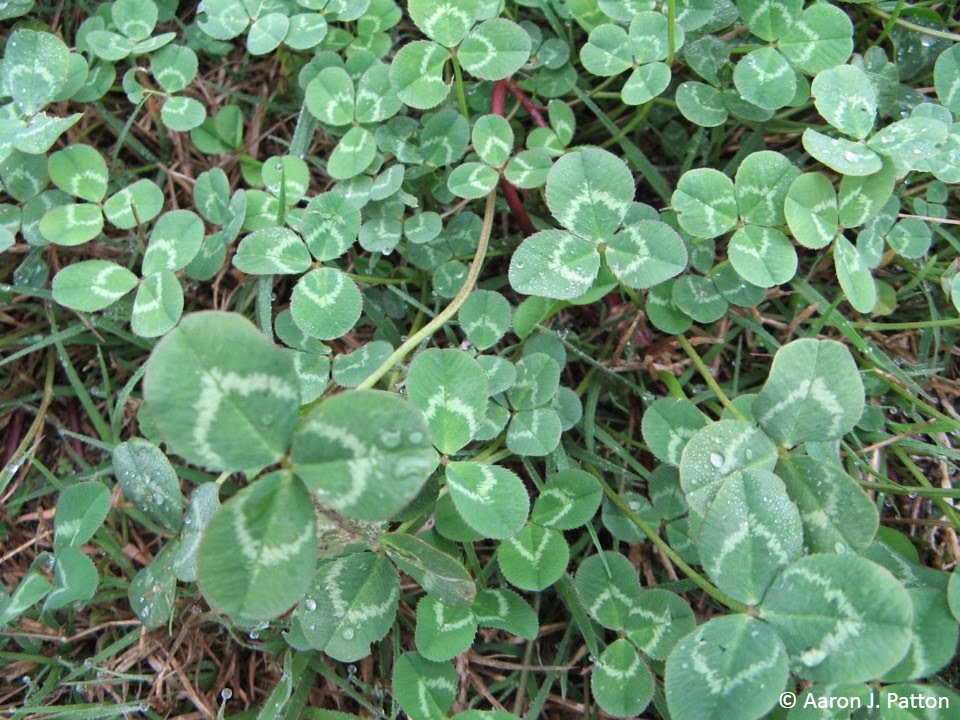
Identification: White clover forms mat-like patches in lawns as it spreads via low-creeping stolons that can grow at a rate of 18 cm per year. Stems can be smooth or sparsely covered with hairs. Leaves are generally arranged in threes; however, occasionally the appearance of 4 leaves can give white clover a ‘shamrock’ or a ‘4-leaf clover’ appearance. Leaves are predominantly egg-shaped, grayish-green on the bottom, and bright-green on top with a distinctive gray-green splotch or watermark at the base. Flowers are white, often with pink tinge, and are arranged in aggregated, rounded heads that can hold up to 85 flowers. Seed coats are extremely hard, thus allowing for extended dormancy periods in the soil. Other trifoliolate (3 leaves) legumes, such as red clover, are similar but generally larger in size, have more pubescent stems, and more elongated leaflets than white clover.


White clover in cool-season turf.

Rounded flower clusters can hole up to 85 flowers.

Pink tinge at the base of white flower petals.

Trifoliate (3-leaf) arrangement with distinctive watermark.

Appearance of 4 leaves produce a 'shamrock' or '4-leaf clover' appearance.
 
White clover in closely mown turf.

Presence of white clover may be an indication of low nitrogen fertility.

Large patches of white clover in dormant bermudgrass turf.
Large patch of dense, mat-like growth.
 
Cultural control: The use of cultural practices, such as increased mowing height, adequate irrigation, and overseeding to enhance cool-season turf density and vigor may help the lawn to out compete white clover infestations. Since white clover is a legume capable of fixing its own nitrogen, adequate nitrogen fertilization will often help to reduce clover and further develop a more competitive turf.

Biological control: None known for specific use in white clover. There are some organic postemergence herbicides available for turf weed control. For example, pelargonic acid (Scythe) and acetic acid (5% or greater solutions) may be used to manage weeds. Other products such as Eugenol, which contain medium-length fatty acids and clove oil, have shown some promise as an effective weed control tool. However, these organic herbicides do not differentiate between the target weed and the desired turf (non-selective) and should only be applied as spot treatments in direct contact with the weed only. As a result, most of these organic herbicides have limited use in turf and are better suited for weed control in parking lots, along fence rows, and in other bare-ground areas.

Many new organic products contain essential micronutrients, such as iron HEDTA (FeHEDTA) as the active ingredient. Though multiple applications of these products are required, turf injury is generally decreased (can actually make the turf darker); however, their ability to provide long-term weed control is not well-documented.

Chemical control: Chemical management of white clover is generally focused on a postemergence strategy over a preemergence strategy because of the few preemergence herbicides available for broadleaf weeds in cool-season turf and because white clover may germinate at different times throughout the year. The best selective herbicide management strategy is repeat applications of two- or three-way mixtures of 2,4-D, dicamba, MCPP. Products that contain one or more of the following ingredients should also provide effective control in cool-season turf: clopyralid, dicamba, florasulam, MCPP, and quinclorac. 

For more information on weed control, search this blog and check out our Turfgrass Weed Control for Professionals Publication.

For archives of past weed of the month postings, visit our Weed of the Month Archive.

Aaron Patton, Turfgrass Extension Specialist
Leslie Beck, Postdoctoral Research Associate
Read More

Weed of the month for September 2013 is Nimblewill

Nimblewill  

Biology: Nimblewill (Muhlenbergia schreberi) is a warm-season perennial grass found throughout the northeast, southeast, and Midwestern United States. It can often be mistaken for other mat-forming grasses with blue-green foliage such as bermudagrass or creeping bentgrass. It grows well in moist, shady areas but it is also found in dry, sunny areas. Nimblewill spreads vegetatively through short, weak stolons and creates patches in lawns that start off small, but then grow into larger patches.

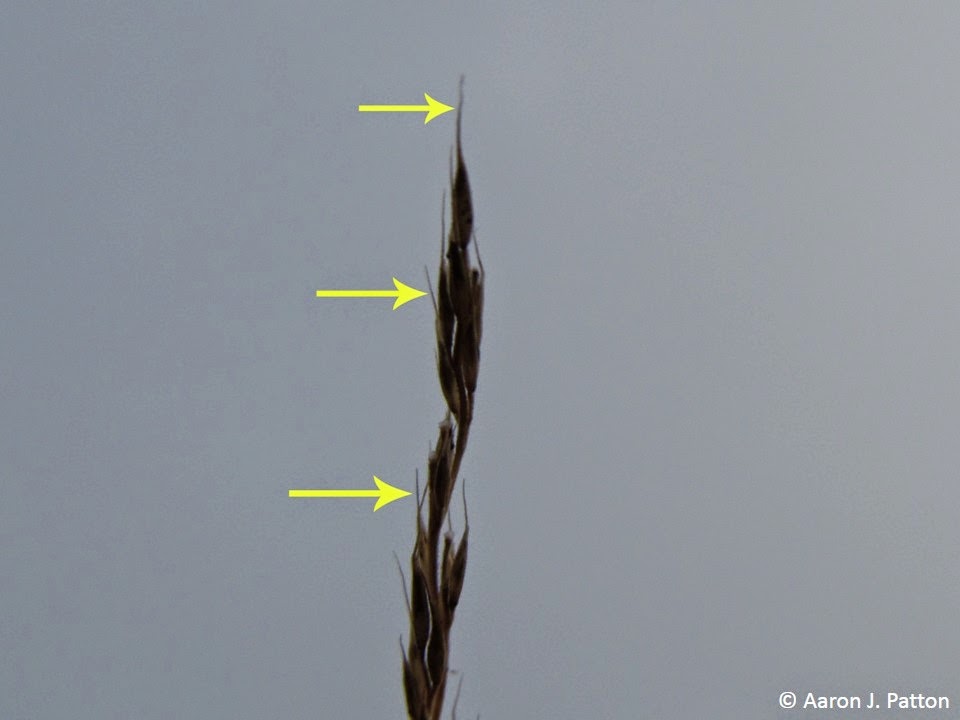
Identification: Nimblewill forms mat-like patches in lawns as it spreads radially via short, weak stolons. It is usually distinguishable in cool-season lawns from its gray-green, coarse textured leaves. Nimblewill patches may be observed during the summer months as cool-season lawns are stressed by heat and drought. It is also easily distinguishable as brown, dormant patches surrounded by green cool-season turf during the winter months. It is often confused with bermudagrass, but has a short, jagged, membranous ligule compared to a hairy ligule on bermudagrass. Nimblewill often produces loose, spike-like panicles in late summer to early fall. Seeds on the seedhead will have long, hair-like awns that help further distinguish nimblewill from bermudagrass.


Nimblewill has short, pointed leaves

Nimblewill seedhead

Nimblewill seedhead with arrows pointing to awns

Dormant nimblewill in a shady lawn. Small patches grow together to form large areas.

New growth in the early spring

Dormant patch of nimblewill in the spring during greenup.

New growth in the early spring

Nimblewill leaves (center) in a cool-season lawn

Blue-grayish colored nimblewill leaves (Center) in a cool-season lawn

Patches of nimblewill that are green during drought. Nimblewill is drought tolerant as shown in this photo.

Nimblewill will have a membranous ligule and sparse hairs and bermduagrass has a hairy ligule and is usually very hairy.

Nimblewill has a small membranous ligule

Cultural control: The use of cultural practices, such as increased mowing height, fall fertilization, and overseeding to enhance cool-season turf density and vigor may help the lawn to outcompete nimblewill infestations.

Biological control: None known for specific use in nimblewill.

Chemical control: There are nonselective and selective control options available for nimblewill. Usually, stoloniferous, perennial grasses are controlled by spot-treating with a nonselective systemic herbicide such as glyphosate (Roundup). For best results, apply when the plants are young and actively growing. However, because nimblewill is capable of re-establishing through surviving stolons, at least two glyphosate applications are recommended, but three or more may be needed for complete eradication. It is important to allow the weed to regrow before making any follow-up applications.

Two new herbicides provide selective control options for nimblewill in cool-season turf. These herbicides are applied at relatively low use rates and homeowners are encouraged to hire lawn care professionals to make applications.

Mesotrione (Tenacity) can be used for selective control of nimblewill growing in a cool-season turf. To control nimblewill, start applying mesotrione in the spring (late-April) with a nonionic surfactant at 0.25% (v/v). You will need to make two or three applications. If you make three applications, use the 5 fl oz/A rate (or 6, 6 and 4 fl oz/A). The product does have a yearly maximum use rate, and the label states “do not apply more than 16 oz of Tenacity per acre per year or per crop (equivalent to a maximum of 0.50 lb of mesotrione per acre per year).” You can also apply mesotrione in late summer and fall, but you should initiate them by August for best results.

Another option is to apply topramezone (Pylex) at 1-1.5 fl oz/A at 21- to 28-day intervals starting in late April. For best results, include a methylated seed oil at 0.5-1.0% (v/v).


For more information on weed control, search this blog and check out our Turfgrass Weed Control for Professionals Publication.

For archives of past weed of the month postings, visit our Weed of the Month Archive.

Aaron Patton, Turfgrass Extension Specialist
Leslie Beck, Postdoctoral Research Associate
Read More

How Big is Your Lawn?

A key step in most lawn maintenance practices such as seeding and fertilizing as well as with double-checking your calibration and application accuracy is to determine the size of the turf area. Determining your lawn area will help you calculate how much seed you need, how much sod to order, how much fertilizer to apply, how much pesticide to measure, and more.
The best way to do determine the area is to divide your turf into several squares, rectangles, or circles (Figure 1). Calculate the area of these smaller shapes and then add them together to determine the total size of the turf.

Figure 1. Common shapes and how to calculate their area.

Figure 2. An example property with dimensions for its lawn, hardscape, landscape, and house.


Area Calculation Example
This example illustrates how you might calculate the area of your lawn. The measurements for this example come from Figure 2.

In this example, the easiest method is to calculate the total area of the property, and then subtract the hard surfaces from that to get the total area of the lawn.

Section of Property
Calculation Area
(square feet)
Total land ((90 ft + 60 ft)/2) x 80 ft 6,000
House 50 feet x 25 feet 1,250
Driveway 15 feet x 40 feet 600
Porch 8 feet x 12 ft 96
Mulch 1 10 feet x 5 feet 50
Mulch 2 25 feet x 5 feet 125
Mulch 3 3.14 x 82 x 0.25 (mulch bed is a quarter circle) 50
Mulch 4 3.14 x 82 x 0.25 (mulch bed is a quarter circle) 50
Total area of objects 2,221
Total turf area (6,000 square feet – 2,221 square feet) 3,779

The total turfgrass area of the lawn is 3,779 square feet.

Turf professionals often use specialty programs, software, or commercial services to help in calculating your lawn's area down to the square foot. Technology has also made this a little easier as various online maps can also be used to estimate your lawn's area. If you are computer savvy, then using Bing or Google maps and measuring tools you can also get an accurate measurement. If you are not computer savvy, then measuring your lawn area the old fashion way as described above will probably be just as quick and possibly easier.

Aaron Patton, Turfgrass Extension Specialist
Read More

Crabgrass Germination Coming Soon!


This time of year many have questions about crabgrass control. Below are several previous Purdue turf tips that answer the most commonly asked questions about crabgrass control.
  1. When will crabgrass germinate?
  2. When should I apply my preemergence herbicide (crabgrass preventer)?
  3. Which preemergence herbicide should I use?
  4. How do I control crabgrass in spring seeded turf?
  5. Do split applications provide better control than a single application?
  6. How to identify crabgrass?
  7. How will the cool spring affect crabgrass control? Originally posted April 22, 2011
  8. How might a late frost affect crabgrass?
Forsythia blooms are an indicator that crabgrass germination is just around the corner. See the link above "When will crabgrass germinate?"
For more information on weed control, search this blog (search box in upper left corner of page) and archived turf tip postings and check out our Turfgrass Weed Control for Professionals Publication

Aaron Patton, Turf Extension Specialist
Read More