Rounds 4 Research

Rounds 4 Research is an innovative program aimed at generating resources to fund research and help ensure golf’s future. The premise is simple: Golf facilities can support the effort by donating rounds of golf for two or four or “stay and play” packages and other items that will be auctioned off online to generate funds for turfgrass research. Rounds 4 Research is administered by the Environmental Institute for Golf (EIFG) and presented in partnership with the Toro Co. The EIFG is the philanthropic organization of the Golf Course Superintendents Association of America.

Each of GCSAA’s 100 affiliated chapters, as well as local turfgrass foundations and other industry partners, will have the opportunity to solicit donated rounds. The EIFG will then distribute monies back to the participating organizations to fund research in their local areas. The Purdue University Turf Program is currently working with local golf course superintendent chapters to help them promote this program. Dr. Aaron Patton, Purdue University Turf Program said that "with grant funds becoming more and more difficult to secure, this program is a great way that local superintendents as well as Purdue University alumni can help support Purdue turf research."

Whether you are an organization looking to solicit rounds or a golfer looking for the opportunity to support research while enjoying the sport you love, Rounds 4 Research provides a way for all aspects of the game to come together to ensure its future.


After launching in July 2012, Rounds 4 Research raised more than $28,000 for turfgrass research in its pilot effort. For 2013, auctions are scheduled for June 6-16 and Aug. 1-11. You can become part of the Rounds 4 Research effort by donating a round from your facility.


If you have questions on how to participate in the Rounds 4 Research program, contact Jennifer Biehl at (765) 494-8039 or at biehlj@purdue.edu


Read More

Caterpillar Update

Although they are fairly easy to control, caterpillars like cutworms and armyworms can have a way of “sneaking” up on turf managers. For golf course superintendents, we’ve reached that point in the spring when black cutworms may be large enough to cause visible damage (»300 Degree Days). Unless you have a preventive program in place, keep an eye out for indications of damage. Black cutworm damage typically appears as small, irregularly depressed areas in tees and greens where the larger larvae have cut the grass down to the soil surface (Fig. 1)

On another note, increasing numbers of adult armyworms have been showing up in light traps around the State. These insects will lay their eggs on turfgrass leaves and stems. When they hatch, an army of hungry caterpillars will begin feeding and moving across the turf. The damage is difficult to notice at first, but as the larvae become larger (Fig. 2), they consume enormous amounts of green grass. Lawns can seemingly disappear overnight (Fig. 3). Areas that tend to be most vulnerable are those that are located next to agricultural fields, and ditches and roadways where tall grass and other vegetation is not mowed.

The following is a short list of recommended insecticides for caterpillar control (not meant to be all inclusive):

Bacillus thuringiensis Kurstaki (Small larvae only)
Beta-cyfluthrin
Bifenthrin
Chlorantraniliprole
Clothianidin
Deltamethrin
Lambda-cyhalothrin
Permethrin
Spinosad
Zeta-cypermethrin

Always read and follow label directions.


Figure 1. Black cutworm damage to a bentrgrass putting green surface. In this instance, cutworm larvae took up residence in openings caused by recent core aerification.


Figure 2. Late instar larva of the common armyworm flushed from tall fescue turf using a disclosing solution containing 1 tablespoon of lemon Joy® dishwashing detergent in 1 gallon of water. Notice the presence of several other larvae in the background.


Figure 3. Damage to a rural Indiana lawn caused by a heavy armyworm infestation. As long as water and fertility are available, the turf will eventually recover.

Read More

Guess Who Came to Dinner?

The photos below were submitted to our laboratory for identification.  While there are no animals present in the photos, the damage depicts the problem very nicely.
Even without seeing any, I am quite certain that the turf is infested with white grubs. 

As you know, white grubs do some damage to grasses, but what damage they cause is sometimes more than compounded by other animals coming in to forage for the grubs. 

Such is the case with this incident.  It is clear that either raccoons, skunks or opossums have been digging for grubs in this area.  The turfgrass ripped up and strewn all around (Photo #1) is evidence of foraging by these animals.

The second photo of ‘peck holes’ is similar evidence of grub foraging but in this case it is caused by birds.  Apparently, they also are enjoying the grub buffet.

Together, these photos show the result of what may have been somewhat tolerable grub injury to a lawn, made intolerable by animal foraging on the grubs.

Since the grass is pretty much dead at this point, the only solution is to rake it up and replant or lay sod.  Laying sod gives a quick fix to the problem, but not all animal foraging damage is this severe.  Keep in mind that any grass that is not torn up will survive and thus give a head-start to an over-seeding strategy.

Consider applying grub control treatments during late July or August to prevent grubs from re-occurring next year.

Grub foraging damage by mammals

Bird peck-holes 

Tim Gibb
 Insect Diagnostician


Read More

Japanese Beetle Emergence Begins

We captured the first Japanese beetle adults of the year last week in our traps on the Purdue Campus. These traps are located in an area where emergence tends to take place much earlier than at most locations, so don’t expect to see any significant wide-scale emergence for another 2-3 weeks. We monitor this particular site in order to be able to provide turf and landscape managers with an early heads-up so they can prepare as necessary. For turfgrass managers concerned about controlling the larvae (white grubs) of this insect, the chart below provides guidance on product selection and timing in relation to expected efficacy.


Doug Richmond
Turfgrass Entomologist


Read More

Spring Diseases in the Midwest

Spring has finally arrived and it is accompanied by the usual compliment of infectious turf diseases.  There should be no confusion between two “rhizoctonia” diseases.  Yellow patch (aka cool season brown patch) prevails during early spring, when rainy weather is combined with cool nights.  It also affects al turf species and the circular patches are most prominent on shorter mown turf (putting greens and surrounds).  Brown ring patch (aka Waitea patch) visits later in the spring evening temperature increases.  It is largely restricted to annual bluegrass.

Melting out on perennial ryegrass and Kentucky bluegrass is flourishing in some stands of taller mown turf (golf course roughs, municipal athletic fields and residential turf).  Red thread and pink patch are bloom, and the solar spot pathogen has awakened and will make its presence known shortly (in my opinion).   

Here in West Lafayette, soil temperature has increased to the point where the summer patch pathogen is emerging from dormancy.  Our soil temperature monitor suggests that we are entering a period when applications of effective fungicides may limit infection.

For more information, including color images of these and other infectious diseases of turf, go to our Purdue Turf Program Website (www.agry.purdue.edu/turf/). 

For more information on weather and turf diseases, go to http://btny.agriculture.purdue.edu/turfcast/

Rick Latin
Turfgrass Pathologist


Read More

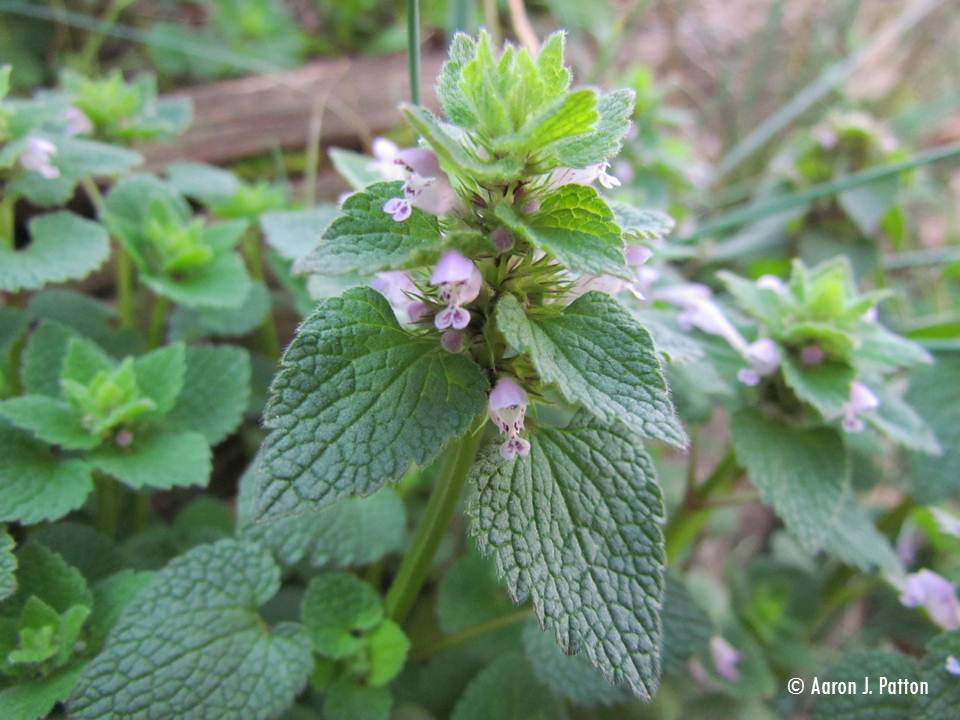
Weed of the Month for April 2013 is Purple Deadnettle

Purple Deadnettle 

Biology: Purple deadnettle (Lamium purpureum) is a common winter annual broadleaf weed found throughout the US. It is closely related to another winter annual broadleaf, henbit (Lamium amplexicaule). Both have vibrant purple flowers that can been seen now in lawns, landscapes, and fields.

Identification: Purple deadnettle is a winter annual meaning that it germinates in the fall, survives the winter as a plant, then flowers, develops seeds, and then dies when temperatures rise in late spring and early summer. Purple deadnettle blooms are mainly visible in April although you can find it blooming earlier and later depending on the area it is growing and the temperatures. Purple deadnettle is a member of the mint family and has a characteristic square stem. Purple deadnettle flowers are light purple in color and are small and tubular in shape.  


Purple deadnettle leaves are triangular in shape with shallow lobes. Typically, the upper leaves are more purple-red in color than the lower leaves.  


Cultural control: Purple deadnettle mainly occurs in turf and soils that are disturbed during the fall when it germinates. Proper mowing (higher mowing heights), proper fertilization (some rather than none to improve turf density), irrigation to prevent summer dormancy during drought, and aerification of compacted areas to improve turf health are all cultural practices that can be used to reduce purple deadnettle. If you only have a few purple deadnettle plants, you can usually pull them by hand.

Biological control: Some organic herbicides are available. Among the postemergence organic herbicides, the most common are pelargonic acid (Scythe) and acetic acid (5 percent or greater solutions). Other products that contain medium-length fatty acids and clove oil (eugenol) show some promise; however, these organic postemergence herbicides are nonselective and can injure actively growing desirable plants in the lawn and landscape, so their use should be limited to directed spot treatments. The bottom line is that most organic postemergence herbicides have limited use in turf and are better suited to weed control in parking lots, fence rows, and other bare ground applications. Many new organic products contain the active ingredient iron HEDTA (FeHEDTA). Multiple applications of this product are required for control. FeHEDTA containing products injure turf less (can actually make turf darker green), but their efficacy for weed control is yet to be well documented.

Chemical control: Purple deadnettle can be controlled using preemergence or postemergence products, but I will mainly discuss postemergence control as preemergence control is more limited to bermudagrass and zoysiagrass lawns.

The more common approach to controlling purple deadnettle in cool-season turf is to use postemergence herbicides after it has already emerged. Most postemergence herbicides including those containing 2,4-D, dicamba, fluroxypyr, and others will control purple deadnettle. As plants get bigger, herbicides will be less effective at controlling this weed. Additionally, since it is a winter annual, it will naturally die in the summer so late spring herbicide applications aren’t necessarily warranted. You can tell that purple deadnettle is beginning to die from summer heat stress when the leaves start to turn yellow in color.


For more information on weed control, search this blog (search box in upper left corner of page) and archived turf tip postings and check out our Turfgrass Weed Control for Professionals Publication.

Aaron Patton, Turfgrass Extension Specialist


Read More

Weather and Turf Diseases

From a temperature perspective, weather patterns in the Midwest have returned to normal this spring.  I recall the 80 F days in March 2012, and all of the concerns about scheduling fungicide sprays.  Hopefully most turf managers have resisted the temptation (regardless of who or what is doing the tempting) to apply fungicides for early season dollar spot control this year.  Fungicides will be effective only if the pathogen is active, and Sclerotinia homoeocarpa becomes active when mild weather prevails—not yet, but we’re getting close!

I also think it is too early for a summer patch spray.  The decision rule suggests that applications targeted towards summer patch should be initiated when soil temperature (2” depth) is 65 F or greater for several days.  There is so much “fudge factor” there.  Little or no hard science went into developing the rule—it’s all empirical.  Keep in mind that the pathogen comes out of dormancy more like a dimmer switch than an “on-off” switch, so it will take a while to ramp up to speed.  We intend to conduct some summer patch trials this summer, so I hope to have something useful to report next year.   

I suspect that symptoms of yellow patch (aka, cool season brown patch) are apparent on bent/poa greens and surrounds.  The heavy rains during the week of April 12 will have aggravated the situation.  Last April, we established a fungicide trial in an area where a yellow patch outbreak was severe—as bad as I have seen it in 15 years or so.  The fungicides included Prostar, Heritage (representing QOI products), Banner Maxx (representing DMI products), Cleary 3336, a chlorothalonil, and an untreated check.  The plots were monitored closely for 4 weeks.  In terms of symptom reduction, there were no differences among treatments, including the unsprayed check.  However, as daily temperatures increased, and the superintendent applied supplemental N, symptoms in ALL plots disappeared within a week.  By June 1, there was no recognizable damage, cosmetic or otherwise, to the turf.

Rick Latin
Turfgrass Pathologist


Read More