Japanese Beetle Adults Emerging


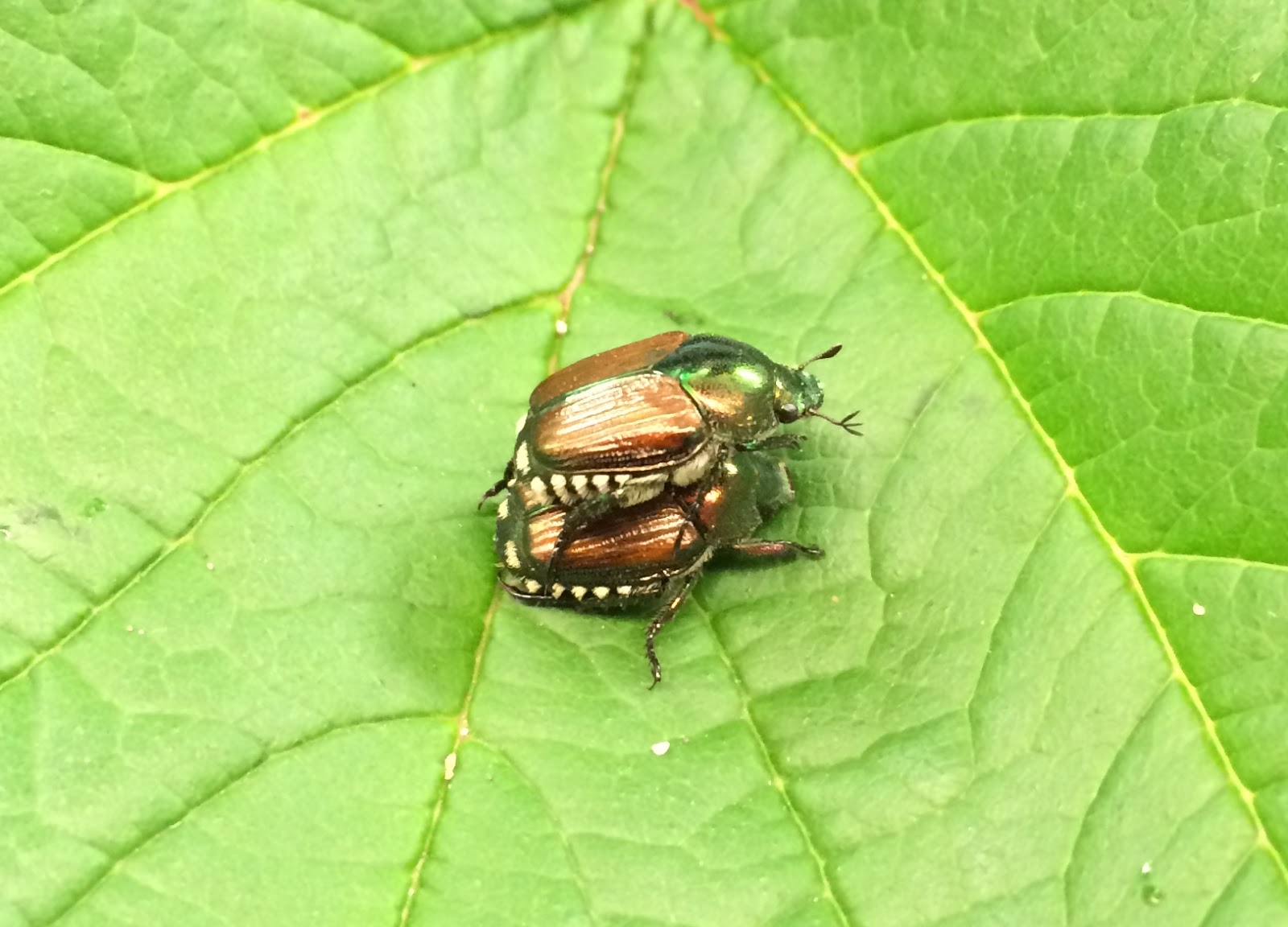
We’ve been seeing a smattering of Japanese beetle adults in our traps for the last few weeks in West Lafayette, but it appears their numbers are starting to increase as we head toward the end of June. Expect to see emergence come into full swing over the next two weeks in this part of the state.
This imported pest is common east of the Mississippi river and in the Mississippi river valley. Adults feed on more than 400 plant species including many common ornamental plants. The soil-dwelling larvae (grubs) damage a variety of plant roots including those of ornamental trees, shrubs, and turfgrasses.


For more information about the biology and management of this insect, visit the following Purdue Extension Entomology links.

Japanese Beetles in the Urban Landscape http://extension.entm.purdue.edu/publications/E-75.pdf
 
Turfgrass Insect Management
http://extension.entm.purdue.edu/publications/E-61.pdf

Doug Richmond, Associate Professor and Turfgrass Entomology Extension Specialist
Read More

Rain, Rain Go Away?

There are a lot of wet areas out there right now as pockets of Indiana have received more than double their monthly expected rainfall. Rain is a good thing but as we know it is possible to have too much of a good thing. Saturated soils reduce turf health and cause issues related to mowing and maintenance (see previous turf tips linked below).

Last 30 days of rainfall.

7-day rainfall predication from June 17 to June 24, 2015 most of the rainfall here is due to Tropical Depression Bill.


Despite our wet period now, the models suggest that Indiana’s summer will have average precipitation with average temperature. The “EC” in these June, July, and August maps highlight that our summer has an equal chance (EC) of being wet or dry and an equal chance of being colder or warmer than average which is a prediction of being an average summer. See this link for a more detailed explanation.


Despite the current rain we need to remember that we will likely encounter some temporary or periodic drought this summer so don't be too quick to wish all the rain away as you might be wishing for some rain later this summer. Short wet and dry cycles are good for turf as it promotes deeper rooting in turfgrasses. This is why we recommend deep and infrequent irrigation. As the summer progresses we will continue to provide you information on turf management and how to adjust/alter your maintenance practices to improve your turf care.

More past turf tips related to rain/flooding:
How to Mow Now That it has Stopped Raining
Rain gardens and turf
Flooding on turf
Dealing With Flood Damage


Aaron Patton, Turfgrass Extension Specialist
Read More

Turf and Landscape Field Day on July 14, 2015

On Tuesday, July 14, 2015 the Purdue Turf Program and the Midwest Regional Turf Foundation will host the Turf and Landscape Field Day. The Turf and Landscape Field Day is Indiana’s largest green industry field day. This will be the third year with landscape research tours added. Specialists from four different departments in the College of Agriculture will share their findings and recommendations to Green Industry professionals. We invite you to join us. Attendees will receive education (with CCHs in categories 2, 3a, 3b, 6, 7a, and RT), listen to research updates, receive product updates from exhibitors, and also network with others in the Green Industry.

The field day will feature about 40 exhibitors representing companies from around the region ranging the gamut from equipment, seed, fertilizers, pesticides, landscape plants, hardscape and more. Last year approximately 525 attendees from Indiana and all its surrounding states attended to learn more about Purdue’s latest green industry research. Attendees came from a variety of backgrounds including business owners, managers and staff of wholesale and retail nurseries, landscape management firms, greenhouse growers, golf course superintendents and staff, lawn care companies, grounds maintenance departments, landscape design and installation firms, garden centers, consulting firms, educational institutions, suppliers and more!

This year’s field day will have three morning research tours and four afternoon tours including a field trip to Purdue Horticulture Research Farm. A spanish speaking sessoin will also be included in the field day this year. We will have sixteen different speakers at the field day including Purdue faculty/staff from Botany and Plant Pathology, Entomology, Horticulture and Landscape Architecture, and Forestry and Natural Resources.

DISCOUNTED PREREGISTRATION DEADLINE: Tuesday, July 7
YOU CAN STILL REGISTER ONLINE for this July 14 event until July 8 at the onsite price
THOSE WISHING TO REGISTER AFTER July 8 should register onsite at the field day at 8:00 am.
Register on-line, US mail, scan/email attachment, fax or call. 
Brochure and Attendee Registration PDF
Register On-line (NEW registration system)
Exhibitor Registration PDF

We look forward to seeing you this year at the Purdue Turf Field Day!  If you have any questions please contact Tammy Goodale at 765-494-8039 or tgoodale@purdue.edu


Read More

Bermudagrass Winterkill Again?

Some are suffering through another year of bermudagrass winterkill in Indiana. Much different than last year where winterkill was widespread and there were many different causes (too cold, too wet, too shaded, etc.), the primary cause for winterkill in 2014-2015 in Indiana appears to be confined to immature bermudagrass. Those that were not able to replant in 2014 until after July 1 or those whose bermudagrass recovered very little in 2014 seem to be hit the hardest. As such, we encourage all those who anticipate planting or replanting bermudagrass in 2015 to try and plant this month (June) to increase the odds of their bermudagrass surviving the 2015-2106 winter.

We are continuing to examine the cold hardiness of various bermudagrass cultivars. Our bermudagrass research plots at Purdue were almost entirely killed this past winter with only one entry, Yukon, seeming to do well thus far. All others were severely injured and we are in the process of reestablishing these bermudagrass plots to try and learn more about the adaptation of certain bermudagrass cultivars to the Midwest. Stay tuned for more results as they become available.


For more information on bermudagrass winterkill, see these previous turf tips.
Warm-season Turf Winterkill 2014: What Can you Expect and NOW WHAT? (March 12, 2014)
Winterkill Here on Bermudagrass! Now What? (June 27, 2014)


For more information regarding bermudagrass winterkill on the east coast this year, read these recent postings.
Winterkill of Bermudagrass in North Carolina
Winterkill hits Carolinas

Aaron Patton and Cale Bigelow
Read More

Weed of the Month for May 2015 is Orchardgrass

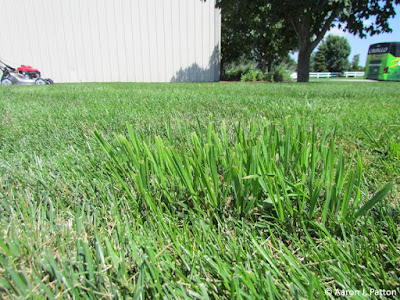
Biology: Orchardgrass (Dactylis glomerata), is a clump-forming, or bunch-type, cool-season grassy weed found throughout the Midwestern United States. It is typically used as a type of grazing or forage grass in pastures but it can be a weed in turf. It’s bunch-type growth pattern, light blue-greenish color, ability to tolerate partial shade, and rapid leaf elongation make orchardgrass a problematic weed (plant out of place) in many lawns.

Identification: Orchardgrass is a bunch-type cool season perennial grass that is commonly found in home lawns throughout the state of Indiana. Orchardgrass often infests lawns as a contaminant in grass seed or in newly established lawns that previously consisted of pasture-land. Orchardgrass can often be found thriving in partially shady conditions that might stress the health of the surrounding, desirable turf. It is easily spotted in lawns when it grows much more quickly and is lighter-green the surrounding turf. Additionally, its bunch-type growth habit doesn’t make a particularly dense canopy when it infests lawns, thus only enhancing its status as a grassy weed.

Its leaves are folded in the bud and have a finely toothed, prominent membranous ligule. As it grows, the leaf blades become very long, are light-green/blue-green in color, and are still slightly rough to the touch on the surface and the outer leaf margins. The membranous ligules grow slightly longer and become more noticeable as the plant matures. The leaf sheaths are strongly compressed and folded. Because orchardgrass has a bunch-type growth habit, the clumps increase in size by developing aggressive tillers which emerge from the base crown of the plant. Orchardgrass also has a very rapid vertical growing rate compared to other desirable cool-season turf which requires more frequent mowing in order to keep a uniform lawn surface. Additionally, the leaf tips have a tendency to tear or shred, even when the mower blades are sharp.

 In the late spring through mid-summer, the plant produces seedheads in a stiff, branched panicle with fan-shaped, densely crowded spikelets of viable seed. The spikelets are often so crowded that when observed from afar, the seedhead almost looks globular or spherical in appearance.  

The prominent membranous ligule of orchardgrass.


A side view showing the compressed sheath/stem and folded vernation.

Orchardgrass has a boat-shaped leaf tip.

Clump of orchadgrass in a shady lawn.

Clump of orchadgrass in a newly seeded Kentucky bluegrass lawn.

Orchardgrass in a newly planted Kentucky bluegrass sod field.

The faster growth habit of orchardgrass is evident here.

Here a mature clump of orchardgrass is growing much quicker than the surrounding turf species.

Orchardgrass seedhead developing in a lawn between mowings.

Cultural control: None known specifically for orchardgrass. Mowing practices alone will not provide adequate management since orchardgrass can survive in many of the same environmental conditions and management programs as other desired turfgrass species. The best method of cultural control for orchardgrass is to avoid contaminating your turf system in the first place by buying certified seed mixtures/blends from a reputable seed company. Carefully read the labels of seed you are purchasing to make sure that orchardgrass is not mentioned as a weed seed. Existing clumps of orchardgrass can also be physically removed by hand, pocket knife or shovel/hoe.

Biological control: None known specifically for control of orchardgrass in cool-season lawns.

Chemical control: Unfortunately, only nonselective control options exist for orchardgrass in cool-season turf. Spot-treating with a nonselective systemic herbicide such as glyphosate (Roundup) will help to manage orchardgrass in cool-season lawns. For best results, apply when the plants are young and actively growing. Often multiple applications may be necessary to completely eradicate the weed; however, it is important to allow the grass to regrow before making any follow-up applications.


For more information on weed control, search this blog and check out our Turfgrass Weed Control for Professionals Publication.

For archives of past weed of the month postings, visit our Weed of the Month Archive.

Aaron Patton, Turfgrass Extension Specialist, Purdue University

Leslie Beck, Weed Extension Specialist, New Mexico State University
Read More

Rounds 4 Research: Auction is Open! Support the Purdue Turf Program

The 2015 Rounds 4 Research auction is now open. The auction will run from June 8 to June 21 with proceeds going to support turf research at Purdue and in Indiana through the Midwest Regional Turf Foundation, advocacy and education programs for the benefit of golf course management professionals, golf facilities and the game.


This fundraiser offers great golf deals and access to exclusive golf courses in Indiana and the nation. 33 foursomes were donated in all in Indiana. So, tell your friends, family, and community to bid on these rounds. Let the bidding begin!

Bid Online Now (https://www.biddingforgood.com/auction/auctionhome.action?vhost=eifg)
 

If you have any questions, please contact the Rounds 4 Research team at mwright@gcsaa.org or 800-472-7878.

Thank you for your support!


Aaron Patton, MRTF Executive Director
Ryan Cummings, Elcona Country Club Golf Course Superintendent and MRTF Rounds 4 Research Coordinator
Read More

Is it Safe to Aerify after Applying a Preemergence Herbicide?


It is not uncommon for me to receive questions regarding whether it is OK to aerify an area when you’ve already applied a preemergence herbicide to control crabgrass. Will aerifying break the herbicide barrier and reduce my crabgrass control? The answer to this and more can be found here in a recent post I wrote at Turf Republic.

To Aerify or Not to Aerify when Using a Preemergence Herbicide


Aaron Patton, Turfgrass Extension Specialist
Read More